

The Throughline
A guest post by Meghan Moravcik Walbert on what her teenage son taught her about career reinvention at midlife

In this week’s guest post, Meghan writes about the realities of working in the dying industry of digital media as she grapples with what the next chapter of her career might look like and as her teenage son figures out what might want to do someday.
“So,” my boss says with a heavy sigh to the remaining nine of us over a Google Meet, “I think the best I can offer each of you is some advice on what to do next. I’m calling it ‘career wellness planning,’ but that’s just a nice way of saying: ‘How to prepare to eventually be laid off.’”
Most of the nine of us had been through it together for years. There were the company-wide layoffs that touched adjacent departments, eliminating people from our daily work lives who weren’t on our team, per se, and weren’t personal friends, exactly, but who still mattered, still meant something to us and the work we did.
Most memorably, though, was the morning a few years ago when the entire team got a last-minute notice for a meeting with the company’s CEO and an HR representative. Anyone familiar with layoffs knows that’s probably not good. And when my manager asked his supervisor for clarification (more specifically, he asked exactly how worried we all needed to be), she simply said, “Just make sure everyone on your team is at this meeting.”
So, we said our informal goodbyes to each other. We said what anyone says in these moments: It’s been really great working with you. We’ve done good work, work we should be proud of; and, hey, we had fun doing it. You never know, we might work together again some day. I hope we do.
Then we signed into the meeting and learned that our website, a digital media tech and productivity site that has been around for more than 20 years and—at least at one point—had a cult following, was not being shuttered; it had been sold.
We were the unicorn success story in a dying industry. Instead of being sold to a private equity firm to be squeezed of any remaining value before being discarded completely, the private equity firm that already owned us was stripping us from their portfolio to sell to a company that actually wanted to invest in us. We didn’t get severance and unemployment; we got raises. We couldn’t believe our luck.
Fast-forward three years, and our current owners, despite the best of intentions (and, frankly, a better business strategy than most), are facing what everyone in the digital media industry is facing: endless Google algorithm changes, an audience that increasingly gets news and information from social media, and “AI overview” summaries that populate at the top of internet searches and position the actual source of the information in the background, never to receive the coveted click. (We do the work; AI gets the credit.)
So on this particular day, six months after losing one team member to a company-wide round of layoffs, and mere hours after losing another team member to more of the same, my manager—who has a partner and two teenagers of his own—shrugs his shoulders and says what we all know to be true: We each need to figure out what is next for us. The clock is ticking on these jobs.
**
A month later, my own teenage son is telling me about his high school schedule for next year; he’s decided to take a woodworking class because he might want to learn carpentry as a career.
“Ooh, really?” I ask. “Ok. If you do, would you make me a dining room table?” (I understand I’m getting ahead of myself here, but I’d really like a nice dining room table, and I figure I might get in line.)
“Of course, Mom,” he says, taking a large bite of a soft pretzel dipped in melted cheese, a favorite of his at this local restaurant where we’re having dinner, just the two of us. “I might not actually become a carpenter, though. I don’t know what to do, but I’m in high school now, so I need to figure it out. I also thought maybe it’d be fun to be a lawyer. Or a marine biologist? But I still kind of want to be a chef, too, and open my own restaurant.”
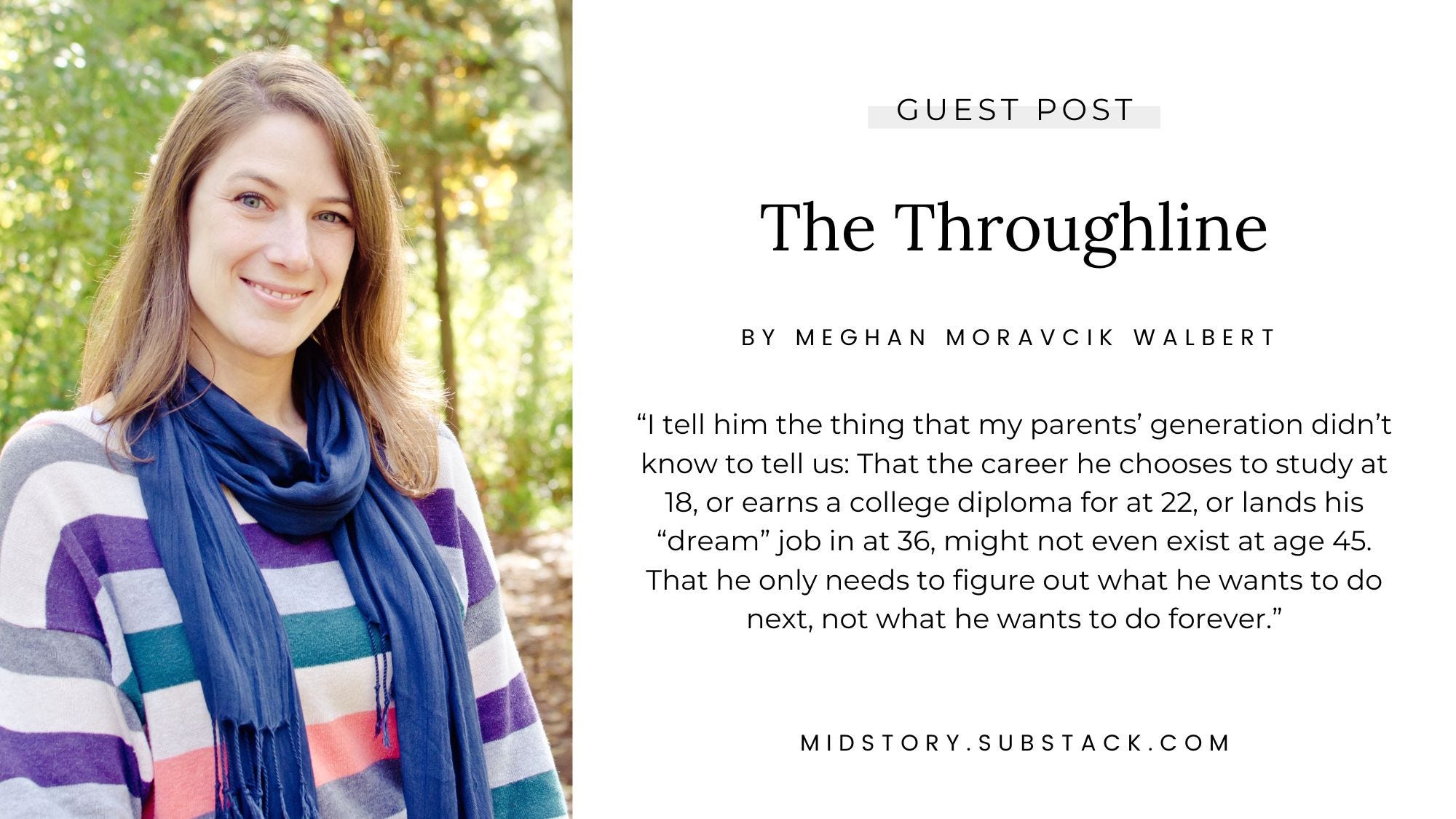
I agree that each of those options sound exciting, and I tell him he has time to figure it out. I tell him the thing that my parents’ generation didn’t know to tell us: That the career he chooses to study at 18, or earns a college diploma for at 22, or lands his “dream” job in at 36, might not even exist at age 45. That he only needs to figure out what he wants to do next, not what he wants to do forever.
So I tell him to look for the throughline in the careers he’s interested in: Do you want to help people? Solve problems? Lead people in some way? Build things? Heal a hurt? If you can figure out the throughline you feel passionate about, I tell him, that can help you narrow choices down in the short-term and give you more of a long-term path to follow. He nods that he understands as he dips a portion of his pretzel in cheese and hands it to me. (The only “throughline” my family has when it comes to eating out is that we sample each other’s food.)
**
From the moment I won a poetry contest in 5th grade, I knew I wanted to write. So circa 2000, as my high school graduation approached, I was trying to figure out how to make a career of writing, and becoming a newspaper reporter seemed to make sense.
I went to journalism school where I learned to fact-check my sources and what one could legally—and ethically—print. I learned to write cleanly, concisely, fairly and descriptively. (Then I learned to use fewer adverbs.) I wrote and edited my way through college, just as news outlets across the country were beginning to figure out that maybe they needed a “website,” too.
I entered the newspaper industry at what felt like a peak of hiring in 2004, and left it in 2009 after the recession caused near-immediate wave after wave of layoffs at the newspaper that I—and my brand new husband—both worked for.
What came next was typical of most journalists fleeing print media: jobs in public relations, media relations or corporate communications. They were jobs that required good writing skills but felt devoid of personal connection or purpose, especially if you weren’t choosy. And one can’t be too choosy as one is paying off all the student loans that prepared one so thoroughly for a dying career.
Over the next several years, I wound my way into motherhood and through several years’ worth of balancing stay-at-home parenthood with freelance writing. When my oldest son turned 8, I landed a full-time role that I told people close to me was basically my dream job: writing (and later editing) full-time for a well-known digital media outlet. Today, it’s the job I’m trying to “career-wellness” my way out of.
**
We meet as a team first, then individually with our editor-in-chief. We have checklists to keep each other accountable. We’re updating resumes and cover letters, we’re drafting the “ah dang, I got laid off, but here’s what I’m grateful for, plus my next steps” messages we’ll eventually post to LinkedIn, and we’re creating “household hardship budgets.”
We laugh and say we hope all the effort is for nothing, but we know it’s necessary; we’re all far too young (relatively speaking) to pretend we’ll retire in digital media. So we also talk about what we each want to do next, what comes after this. And this is where I stumble: I’m just a 15-year-old again, eating a pretzel, sipping a lemonade and thinking, well, I could be this or that or what if I...
Ideas start to bubble up to the surface, though: At my heart, I’ll always identify as a writer. But that’s not the full story of what I want out of a career, or out of life. I want to share human experiences, people’s stories. I want kids without a voice to feel heard. I crave deeper connection with others. I want my work to mean something, both to me and to the people it is meant to serve.
I’m not sure one job can accomplish all that. But I’m also not looking at what to do forever; I’m just trying to figure out what to do next.
Meghan Moravcik Walbert has more than two decades of experience as a journalist and writer and currently works full time as the Managing Editor for Lifehacker.com. She's a former foster parent and is raising her two teenage boys (plus a terrier and a number of fish at any given moment) with her husband in Eastern Pennsylvania.

Do you have your own story to tell? Submit your writing to Midstory Magazine.
 | A guest post by
|
This is so relevant. I feel much concern for young people choosing careers - and having no idea if it will even be a thing in a few years. The world is changing so quickly. Employment may have an entirely different role in what it means to be human.
Thank you for this. In a family of adults who all work in areas affected by AI, the future is terrifying. Your post gives me at least an idea for a way forward. Will be sharing it with my adult children.